

Phone
+86-731-82250427
Address
25th floor, C3 Building, Wanda Plaza, Kaifu District, Changsha, Hunan Province, China.
 Nov 17 2026
Inconel 713C is a cast, γ′-strengthened nickel-base superalloy supplied to investment foundries as remelt stock — ingot, cut bar or electrode form. You buy it for one reason: reproducible chemistry heat after heat, so a supplier change does not cost you castings. This page covers form and unit weight, chemistry, gas content, batch consistency, melting behaviour, return scrap, and the documents that come with each lot.
You are not buying a bar. You are buying acharge— a weighed, chemistry-controlled input that goes into your vacuum induction furnace and comes out as turbine blades, nozzle guide vanes, turbocharger wheels or integral rotors.
That changes what matters:
| The question on the RFQ | The question behind it |
|---|---|
| "Price per kg" | Cost peracceptable casting |
| "Chemistry to spec" | Will mypouring temperature windowstill work next lot? |
| "Lead time" | Do I have tore-qualify my processafter switching? |
| "In stock?" | Can I avoid asingle-sourceshutdown? |
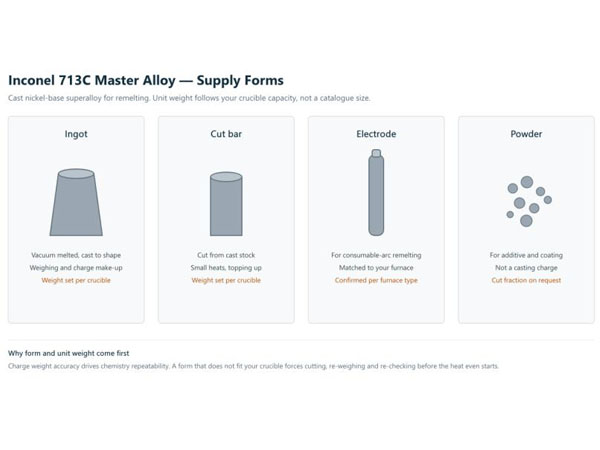
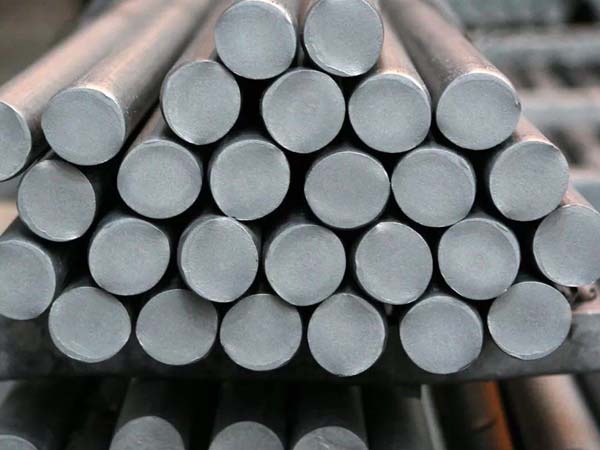
Form and unit weight.We supply ingot, cut bar, and electrode-form stock. Unit weight is set against your crucible capacity and charge make-up — tell us your furnace size and we cut to a weight you can weigh and load without re-cutting. Electrode-form stock is quoted per furnace type and drawing, not from a catalogue.
713C relies on a high γ′ volume fraction (Al + Ti + Nb around 9 wt%) for strength to roughly 980 °C. That same chemistry is why the alloy cannot be wrought — it is a casting alloy, full stop. Anyone offering "713C forged bar" is either mislabelling or selling you something else.
Typical specification range, wt%:
| Ni | Cr | Al | Ti | Mo | Nb | C | B | Zr | Si | Mn | Fe | S | P |
|---|---|---|---|---|---|---|---|---|---|---|---|---|---|
| bal. | 11.5–13.0 | 5.5–6.5 | 0.5–1.0 | 3.8–4.5 | 1.8–2.5 | 0.08–0.20 | 0.008–0.020 | 0.05–0.15 | ≤0.50 | ≤0.25 | ≤1.0 | ≤0.015 | ≤0.015 |
(Confirm the controlling range against your purchase specification — AMS, GB/T 14992 or your internal standard. The table above is a reference envelope, not a substitute for your drawing.)
The part that decides your yield:aluminium and titanium burn off in the crucible. If the master alloy is supplied at the middle of the range, your remelted heat lands at the bottom of the range — or below it. Master alloy for remelt should be set toward theupper-middleof the Al and Ti windows, so that after melt loss the casting sits on the composition your process was qualified at. Ask any supplier where in the window they aim. A vague answer is the answer.
B, Zr and C deserve their own line on the certificate. They are present in hundredths of a percent and they control grain boundary behaviour and castability. A lot that is "within spec" on the majors can still cast badly if the minors drift.
Gas is where a cheap lot hides. It is invisible on the chemistry certificate unless you ask for it, and it shows up later as porosity, oxide inclusions, nitride hard spots and thermal tearing.
| Element | Commonly specified ceiling | Method | What it does to your casting |
|---|---|---|---|
| O | ≤ 30 ppm | Inert gas fusion, IR | Oxide films and inclusions → porosity, hot tearing |
| N | ≤ 20 ppm | Inert gas fusion, thermal conductivity | Nitride particles → hard spots, fatigue initiation |
| H | ≤ 5 ppm | Inert gas fusion | Gas porosity, especially in thick sections |
These are example ceilings, not a claim — agree the actual limits with us before the order and put them on the certificate. A supplier who cannot state a gas limit is not controlling gas.
The expensive failure in this business is not a bad lot. It is agood lot from a different supplier.
Your process — pouring temperature, shell preheat, cooling, HIP schedule — was tuned to a specific set of numbers. When a new supplier's Al sits 0.4 wt% lower, the alloy's liquidus moves, your window narrows, and you find out through three scrapped heats and a week of re-tuning. Nobody invoices you for that.
What to demand, and what to check on arrival:
Reference values — confirm against your own trial before committing a production heat:
| Parameter | Reference |
|---|---|
| Density | 7.91 g/cm³ |
| Melting range | approx. 1,260–1,340 °C |
| Typical pouring temperature | approx. 1,450–1,520 °C, by section thickness |
| Crucible | Alumina or spinel; avoid systems that react with high Al + Ti |
| Shell system | Check binder compatibility — high-Al/Ti alloys reduce silica-bearing systems |
The shell note is not boilerplate. A lot of "bad alloy" turns out to be a shell reaction. If a new lot casts worse in the same shell, test the shell before you blame the metal.
You will generate runners, gates and rejects, and you will want to put them back in the crucible. That is normal and it is fine — within limits.
What we will tell you, in writing: whether we supply return scrap, what fraction is acceptable, how it must be cleaned and segregated, and which elements need topping up after a high return fraction. What we will not do is let you discover the limit through a failed heat.
Every lot ships with:
Audits.We welcome customer audits and third-party inspection (SGS, BV, TÜV or your nominated agency). Melting records, sampling records and packing records are open for review — schedule a visit and we will walk you through the melt shop rather than email you a PDF.
Is 713C forgeable?No. It is a cast alloy. High γ′ content makes it crack in hot working. There is no wrought 713C bar.
Is the master alloy HIP'd?No. HIP is a post-cast treatment for your castings, not for remelt stock. Be cautious with a supplier who mixes the two up.
Why not buy the cheapest lot?Because the cost lands later, in scrap and re-tuning. Compare cost per acceptable casting, not price per kg.
Can I get a specific unit weight?Yes — tell us your crucible capacity and we cut to a weight you can load directly.
Do you supply electrode-form stock?Quoted per furnace type and drawing. Send the details and we will confirm feasibility rather than guess.
713C or 713LC?713LC is the low-carbon variant — better ductility and fatigue behaviour, slightly lower strength. Thin-wall and fatigue-critical parts usually go 713LC; strength-driven parts stay on 713C.
Can K418 substitute for 713C?Close, not identical. Chemistry and minor-element tolerances differ. Treat as a re-qualification, not a drop-in swap.
What about export control?Classify per item against the Chinese dual-use list and the EAR before you assume either way. We will provide the material and end-use information you need for that determination.
What is your MOQ?Send the grade, unit weight, monthly tonnage and controlling standard. We quote against that, and we would rather quote accurately than quote low.
Send four things and you get a real answer, not a brochure:
→[RFQ form]· drawings and specification sheets welcome